Modern supplement brands increasingly need ingredient formats that can move across capsules, sachets, powders and functional beverages without forcing the same formulation strategy on every product. For a multi-nutrient ingredient such as Vitamin B complex, buyers therefore need to look beyond the list of vitamins and consider delivery format, dispersibility, dosage design and finished-product compatibility.
Liposomal Vitamin B Complex powder combines multiple B vitamins with a phospholipid-based liposomal delivery approach. For formulation teams, the key questions are which B vitamins and amounts are included, how the powder behaves in the intended dosage form, whether it is water-dispersible, and whether the supplier can provide consistent specifications and quality documentation. The right ingredient should be selected according to the finished product rather than on a generic claim that liposomal delivery is automatically superior.
The following guide explains what is inside a liposomal B complex, why liposomal delivery can matter in a multi-vitamin formulation, how the powder can fit different supplement formats, and what supplement brands should verify before sourcing it commercially.
What Is Inside a Liposomal Vitamin B Complex?
A Vitamin B complex is not a single vitamin. It is a combination of several B vitamins that may be brought together in one supplement formulation. A complete B-complex concept commonly covers B1, B2, B3, B5, B6, B7, B9 and B12, although the exact forms and amounts depend on the ingredient specification.
In a liposomal Vitamin B complex powder, these vitamins are incorporated into a phospholipid-based delivery system and supplied as a dry powder for further formulation. This distinction matters for B2B buyers because the ingredient is not simply a conventional premix with the word 'liposomal' added to the label; its physical form, dispersibility and specification need to be evaluated as part of product development.
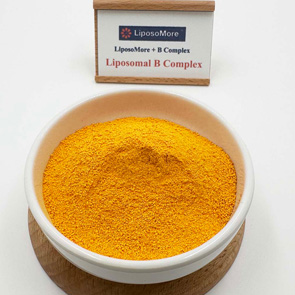
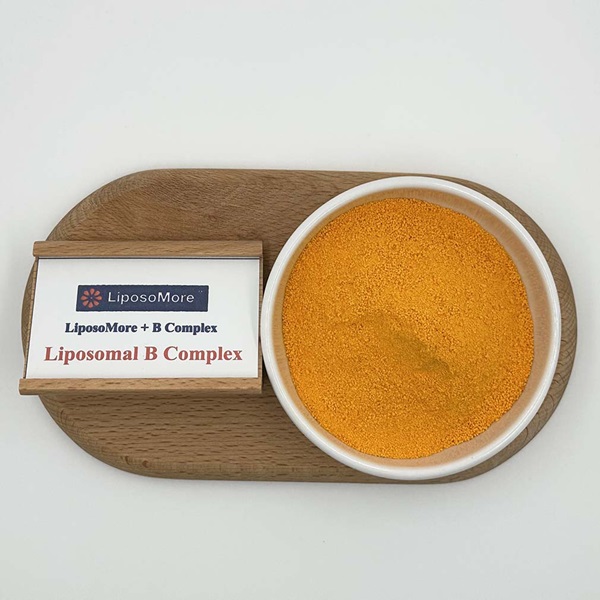
For reference, LiposoMore's current specification lists all eight B vitamins in a 500 mg complex and describes the material as an orange or yellow, odorless powder that is dispersible in water. Those details are useful when a formulation team is assessing serving size, label targets and whether the powder can be integrated into the desired format.
B vitamin | Form listed in current specification | Amount per 500 mg complex |
B1 | Thiamine HCl | 1.5 mg |
B2 | Riboflavin | 1.6 mg |
B3 | Niacin | 16 mg |
B5 | Pantothenic Acid | 5.5 mg |
B6 | Pyridoxine HCl | 2.2 mg |
B7 | Biotin | 150 mcg |
B9 | Folic Acid | 400 mcg |
B12 | Cobalamin | 6 mcg |
The ingredient specification should always be the source of truth. Brands should not assume that every B-complex powder on the market uses the same vitamin forms, ratios or potency.
Why Liposomal Delivery Matters in Multi-Vitamin B Formulations
Liposomal delivery uses phospholipid-based structures as a delivery approach for active ingredients. In a multi-vitamin B formulation, its practical value should be considered in terms of ingredient format and finished-product design, not only consumer-facing absorption claims.
B vitamins are water-soluble nutrients, but a commercial formulation still has to manage issues such as ingredient compatibility, powder handling, dispersion, moisture, processing conditions and stability over shelf life. A water-dispersible liposomal powder can give product developers another format to evaluate for applications where a conventional dry blend may not provide the desired product positioning or processing behavior.
For this reason, brands should avoid treating 'liposomal' as a shortcut for guaranteed higher bioavailability. Any claim about absorption or performance should be supported by evidence relevant to the specific ingredient and finished product. From a sourcing perspective, the more useful questions are how the ingredient is produced, how consistently it disperses, what specifications are controlled, and how it performs in the intended dosage form.
How Liposomal Vitamin B Complex Powder Fits Capsules, Sachets, Gummies and Functional Beverages
The same raw material can behave differently across dosage formats, so the best format depends on the product concept and processing conditions. Liposomal Vitamin B Complex powder can be evaluated across several common supplement formats, but each requires a different formulation checklist.
Finished format | Why the powder may fit | What formulators should check |
Capsules | Straightforward dry-format use | Fill weight, blend uniformity, flowability and serving size |
Sachets / powder sticks | Supports single-serve powder concepts | Dispersibility, taste system, moisture protection and powder flow |
Gummies | Allows a B-complex concept in a consumer-friendly format | Heat exposure, pH, flavor interactions, active retention and process compatibility |
Functional beverages | Water dispersibility can support beverage development | Dispersion stability, sedimentation, pH, flavor, processing and shelf-life testing |
A format should not be selected simply because the ingredient is described as water-dispersible. Beverage and gummy systems are especially sensitive to pH, heat, taste, color and storage conditions, so finished-product testing remains necessary. Capsules and dry sachets may involve fewer liquid-system variables, but they still require checks for dose uniformity, moisture and physical handling.
What to Evaluate When Sourcing Liposomal Vitamin B Complex Powder
For supplement brands, the sourcing stage is where a promising ingredient becomes a commercial formulation decision. A useful supplier review should cover both nutritional composition and manufacturing quality.
· B-vitamin composition: Confirm which B vitamins are included, their chemical forms and the declared amount of each vitamin.
· Physical specification: Review appearance, odor, powder condition and water-dispersibility rather than relying only on marketing descriptions.
· Moisture control: Check loss-on-drying limits because moisture can affect storage and powder handling.
· Heavy metals: Review limits and test methods for total heavy metals, lead, mercury, cadmium and arsenic.
· Microbiological quality: Check total plate count, molds and yeasts, and pathogen requirements such as E. coli and Salmonella.
· Application compatibility: Ask whether the ingredient has been evaluated for the intended capsule, sachet, gummy or beverage process.
· Batch consistency: Commercial products need repeatable composition and physical performance across production lots.
· Documentation: Request the specification, COA and any quality or regulatory documentation required for the target market.
· Technical support: For new formats, formulation guidance and responsive technical communication can reduce development uncertainty.
LiposoMore's current specification, for example, includes limits for loss on drying, total heavy metals, Pb, Hg, Cd and As, together with total plate count, molds and yeasts, E. coli, Salmonella and Staphylococcus aureus. Buyers should still request the latest batch documentation rather than relying on a web-page specification alone.
FAQs About Liposomal Vitamin B Complex
What vitamins are included in a liposomal Vitamin B complex?
A complete B-complex formulation can include B1, B2, B3, B5, B6, B7, B9 and B12. The exact forms and amounts vary by supplier, so buyers should check the product specification.
Is liposomal Vitamin B Complex powder water soluble or water dispersible?
These terms should not be used interchangeably. LiposoMore currently describes its product as dispersible in water. For beverage or liquid applications, formulators should still test dispersion stability in the actual finished-product system.
Which supplement formats can use liposomal Vitamin B Complex powder?
It can be evaluated for capsules, sachets, gummies, functional beverages and other supplement formats when the ingredient specification and processing conditions are compatible with the finished product.
Does every Vitamin B complex contain all eight B vitamins?
No. B-complex products can differ in composition and dosage. Commercial buyers should verify which vitamins are included and in what amounts before comparing suppliers.
What quality specifications should supplement brands request?
At minimum, review composition, physical properties, moisture, heavy metals, microbiological limits, storage requirements and the supplier's batch documentation. Additional requirements depend on the target market and dosage form.
How should liposomal Vitamin B Complex powder be selected for a new product?
Start with the target serving and dosage format, then evaluate composition, powder behavior, processing compatibility, stability, regulatory requirements and supplier documentation. Product-specific trials should confirm the final formulation.
For supplement brands and manufacturers evaluating a multi-B-vitamin ingredient, liposomal vitamin B from LiposoMore provides a current eight-vitamin B-complex powder option for formulation development. Its published specification includes water dispersibility and defined nutritional, heavy-metal and microbiological parameters. Buyers should review the latest specification and batch documentation with the supplier and confirm performance in the intended finished product before commercialization.
Note: This article is intended for ingredient and formulation discussion and does not establish medical, therapeutic or product-specific clinical claims.
Natalie Wu
Hey Guys, I am Natalie Wu, an R&D researcher at LiposoMore. I graduate from College with a Master’s Degree in Bioengineering, I would like to share news and the science behind liposomal ingredients. At LiposoMore, we drive ingredient development with scientific precision and a passion for advanced nutritional technologies.
 EN
EN
 jp
jp  ko
ko  fr
fr  de
de  es
es  ru
ru  pt
pt  ar
ar  pl
pl  vi
vi